
Agentic AI Is Here — What Small Businesses Need to Know
The biggest shift in AI since ChatGPT is already underway
Nearly 98% of U.S. small businesses now use at least one tool powered by AI. Most of them are chatbots, writing assistants, or scheduling helpers. Useful, but limited. You ask a question, you get an answer. You type a prompt, you get a draft. The AI waits for you to do the next thing.
That model is changing fast. The new wave is called agentic AI — systems that do not just respond to your requests but autonomously complete multi-step tasks on your behalf. Book the appointment. Follow up with the customer. Reorder the inventory. Respond to the review. All without you lifting a finger.
This is not a prediction about some distant future. Gartner forecasts that 40% of enterprise applications will embed task-specific AI agents by the end of 2026 — up from less than 5% in 2025. And the agentic AI market is expected to hit $10.86 billion this year, nearly doubling from 2025.
For small businesses, this shift matters more than any AI development since ChatGPT launched. Here is what agentic AI actually means in plain English, how it differs from the tools you already use, and how to adopt it without getting burned.
What agentic AI actually means in plain English
Strip away the buzzwords and agentic AI is simple: it is software that can plan, decide, and act — not just answer.
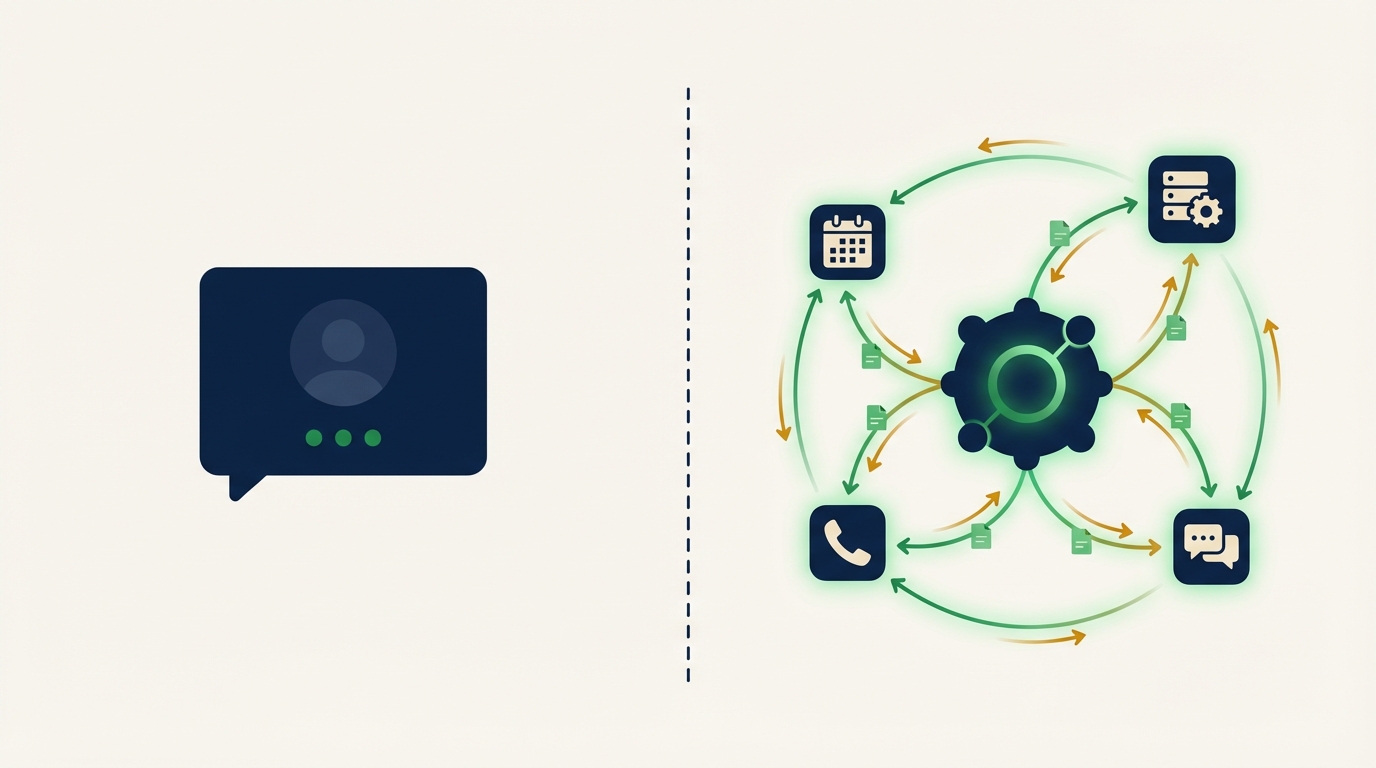
A traditional AI tool is reactive. You give it an input, it produces an output. A chatbot answers a question. A writing tool generates a paragraph. A scheduling assistant shows you open time slots. Each interaction is a single step with the human doing the coordination between steps.
An AI agent handles the full workflow. When a customer texts your plumbing company at 9 PM about a leaking pipe, an agentic system does not just reply with your business hours. It asks clarifying questions about the severity, checks your technicians’ schedules, books the first available slot, sends the customer a confirmation with an ETA, and logs the interaction in your CRM. Five steps, zero human involvement.
The key difference is autonomy. Agentic AI systems have three capabilities that standard AI tools lack:
- Planning — they break a goal into subtasks and work through them in sequence
- Tool use — they connect to calendars, CRMs, phone systems, and messaging platforms to take real action
- Memory — they remember past interactions and use that context to make better decisions over time
Google Cloud’s Carrie Tharp described the shift well in a U.S. Chamber of Commerce report: AI is evolving “from a passive tool that offers prediction, to active, autonomous resources [that] can execute complex, multi-step, prescriptive actions across every consumer and operational touchpoint.”
How agentic AI differs from chatbots and copilots
If you have used ChatGPT, a website chatbot, or an AI copilot in your email, you have experience with the tools that came before agents. Understanding the differences helps you evaluate what is worth your money.
| Capability | Chatbot | AI copilot | AI agent |
|---|---|---|---|
| Answers questions | Yes | Yes | Yes |
| Generates content on request | Limited | Yes | Yes |
| Takes action in other systems | No | Limited | Yes |
| Handles multi-step workflows | No | No | Yes |
| Works without human prompting | No | No | Yes |
| Learns from past interactions | No | Partially | Yes |
| Works across channels (phone, text, email) | Rarely | No | Yes |
Chatbots are rule-based responders. They follow scripts. When a question falls outside the script, they fail. Most website chat widgets fall in this category.
AI copilots are smarter — they use large language models to understand context and generate responses. GitHub Copilot, ChatGPT, and similar tools fall here. They are powerful assistants, but they wait for your instruction at every step.
AI agents close the loop. They take your business rules, connect to your systems, and execute tasks end to end. A copilot helps you write the follow-up email. An agent sends it, tracks the response, and schedules a callback if the customer does not reply within 24 hours.
The practical implication for small businesses is this: copilots save you time on individual tasks. Agents eliminate entire categories of work.
Real examples of agentic AI for small businesses
This is not just theory. Agentic AI is already running in small businesses across multiple industries. Here are concrete examples of what these systems do today.
After-hours phone handling
A heating and cooling company in southern West Virginia used to lose an estimated 30-40% of inbound calls to voicemail — mostly after hours and during peak season when every technician was on a job. An AI agent now answers every call, qualifies the service request, checks crew availability, and books the appointment. No human involved until the technician shows up at the door.
This is exactly what Dispatch, one of Appalach.AI’s AI Employees, does for HVAC, plumbing, and electrical contractors. The agent handles the entire intake-to-booking workflow across phone, text, and web chat.
Review management at scale
A restaurant group managing four locations was spending 10 hours per week crafting individual review responses. An agentic system now monitors Google, Yelp, and Facebook in real time, drafts personalized responses (not templates), flags critical negative reviews for human attention, and posts the rest automatically. Response time dropped from 48 hours to under 30 minutes.
Lead qualification and follow-up
A real estate agency was losing leads because agents could not respond fast enough. An AI agent now fields every inquiry within seconds, asks qualifying questions about budget, timeline, and property preferences, scores the lead, and schedules a showing with the right agent. The human only gets involved when the lead is warm and ready.
Inventory reordering
A small retailer tracks sales velocity and automatically generates purchase orders when stock hits reorder points. The agent factors in seasonal patterns, supplier lead times, and current promotions — something a spreadsheet cannot do without constant manual updating.
These are not pilot projects. A Zapier survey found that 72% of businesses already use or plan to use AI agents in 2026. And a RingCentral report showed that businesses using AI agents reported increased productivity (61%), faster workflows (58%), and improved customer experience (49%).
Risks and guardrails — when autonomous AI goes wrong
Agentic AI is powerful, but autonomy cuts both ways. Giving a system the ability to act without human approval means it can also make mistakes without human approval.
Here are the real risks and what to do about them.
The 40% failure rate
Gartner projects that over 40% of agentic AI projects will be canceled by 2027. The primary culprits: costs that spiral beyond expectations, unclear ROI, and governance gaps. We covered this in depth in our analysis of why AI agent projects fail and how to beat the odds.
The pattern is consistent: businesses that start with a narrow, well-defined use case succeed. Businesses that try to “deploy agentic AI across the organization” burn through budget with nothing to show for it.
Hallucinations and bad actions
AI agents can still get things wrong. A scheduling agent might double-book a time slot if your calendar integration has a sync delay. A review response agent might misread the tone of a sarcastic review. An intake agent might promise a service you do not offer.
The guardrail is simple: start with human-in-the-loop for high-stakes actions. Let the agent handle the routine 90% autonomously, but route anything unusual — complaints, large transactions, ambiguous requests — to a human for review. As trust builds, you widen the autonomy.
Data privacy and security
AI agents that connect to your CRM, calendar, and messaging platforms have access to customer data. This is not a theoretical risk — 52% of businesses cite data quality and availability as their biggest AI barrier, and cybersecurity is a top concern for 34%.
Choose providers that are transparent about where data is processed, how it is stored, and what compliance certifications they hold. If an AI vendor cannot clearly explain their data handling practices, walk away.
Vendor lock-in
Some agentic AI platforms create deep dependencies on proprietary systems. Before you commit, ask: Can I export my data? Can I switch providers without losing my workflow configurations? What happens to my customer interaction history if I cancel?
How to start with AI agents today
You do not need to overhaul your entire operation to benefit from agentic AI. The smartest approach is to start small, prove value fast, and expand from there.
Step 1: Identify your highest-volume, lowest-complexity task
Look at where you and your team spend the most time on repetitive work. Common starting points:
- Answering phone calls and qualifying leads
- Responding to online reviews
- Scheduling appointments and sending reminders
- Following up with leads who went cold
- Processing routine customer inquiries
These tasks share three qualities that make them ideal for an AI agent: they happen frequently, they follow a predictable pattern, and getting them wrong is not catastrophic.
Step 2: Choose a purpose-built solution
Generic AI platforms require you to configure everything from scratch. Purpose-built agents arrive pre-trained for your industry and workflow. An AI Employee built for restaurants already knows how to handle reservations, menu questions, and review responses. One built for auto repair shops understands service scheduling and bay availability.
The difference in time-to-value is dramatic. A generic setup might take weeks of configuration. A purpose-built agent can be operational within 24 hours.
Step 3: Measure before and after
Before you deploy an agent, document your current performance: How many calls do you miss? What is your average response time to a new lead? How many hours per week does your team spend on review management?
After 30 days with an agent, measure the same metrics. A First Page Sage study found that AI agents save an average of 66.8% of time compared to manual task completion. That is a measurable result, not a vague promise.
Step 4: Expand gradually
Once your first agent proves its value, look for the next workflow to automate. Maybe you started with after-hours call handling and now want to add review management. Or you began with lead qualification and want to add automated follow-up sequences.
The key is that each new agent should have its own clear purpose, its own success metrics, and its own human oversight plan. Resist the urge to deploy everything at once — that is how you end up in the 40% that fails.
The competitive window is closing
LinkedIn Economist Sharat Raghavan put it plainly in a U.S. Chamber of Commerce report: “AI has moved from a tool to a strategic asset for small businesses aiming to stay resilient and grow in 2026.”
Major retailers like Walmart, Target, and Home Depot are already deploying agentic AI across their operations. When the big players move, customer expectations shift for everyone — including the small businesses competing in the same markets.
In Appalachian communities, where businesses run leaner and margins are tighter, the efficiency gains from agentic AI are not a luxury. They are a competitive necessity. Every call you miss, every review you leave unanswered, every lead that goes cold is a customer your competitor captures instead.
The good news is that you do not need enterprise budgets to get started. Purpose-built AI agents like Appalach.AI’s AI Employees start at $149 per month — less than a single day of a part-time employee’s wages. And tools like Hollr, our free AI-powered intake widget, let you test agentic-style lead capture with zero risk and zero cost.
Agentic AI is not a trend to watch. It is a shift to act on. Start with one workflow, prove the value, and build from there.
Explore AI Employees and find the right agent for your business